
Learning Through Play: Everyday Ideas Without Worksheets
Published
Learning through play does not require turning every game into a lesson. In everyday play, children can compare, plan, describe, test, and try again. Your role can be as small as making materials available or joining a story your child has already started.
The American Academy of Pediatrics describes play as a way toddlers learn. The examples below are practical invitations for children around ages 4–6, not a checklist of skills they should demonstrate.
Sort for a real reason
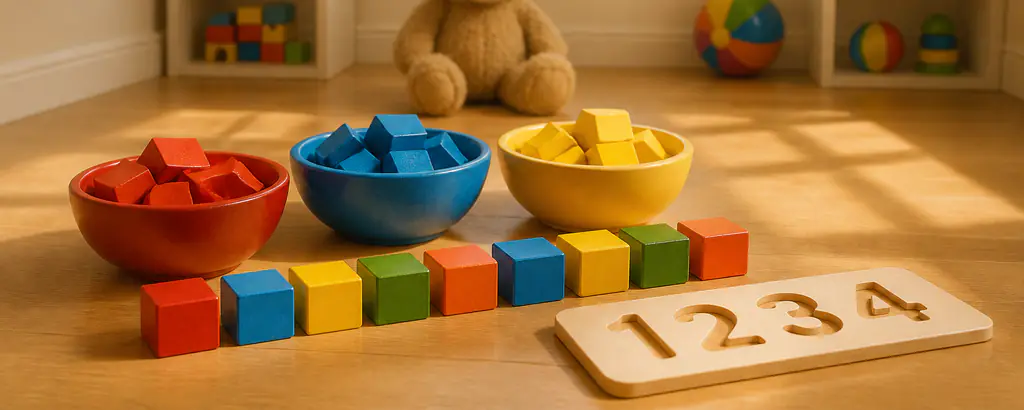
Instead of asking a child to sort a pile simply because you said so, give the sorting a purpose. A toy store needs shelves for vehicles and animals; a pretend laundry needs matching socks. Begin with a small selection and let your child choose which items belong together.
Useful language might be “How did you decide?” or “Where could this one go?” Avoid correcting a category before understanding their rule. They may be sorting by a story rather than color or size.
Count when the game needs a number
A pretend café needs a cup for each customer. Set out three toys and invite your child to give each one a cup. Count together if it helps, or simply notice whether any customer is missing one. Add another visitor only when the first arrangement is comfortable.
This keeps the number connected to an action instead of interrupting play for a quiz. Our role-play guide offers more everyday scenarios.
Let a building problem stay interesting
A vehicle will not fit under a bridge. Pause before fixing it. Your child might raise the bridge, choose a smaller vehicle, or create a road around it. Each solution changes the game in a different way.
If they ask for help, offer a small choice rather than rebuilding everything yourself. “Shall we move the supports or try another roof?” gives them a manageable decision.
Make room for stories in pictures
Look through a book or a child's drawing and wonder what might happen next. Let them point, act, or speak their response. You can write down dictated words, but you do not need to turn every story into writing practice.
Return to a favorite story and invent another ending. Familiar characters leave more room to focus on the new idea.
Change one thing and observe
Roll a large toy car over a smooth floor and then a flat towel. Ask what your child notices about the movement. Try again without insisting on a scientific explanation. Older children may enjoy making predictions or drawing the results; younger children may simply repeat the action.
Know when to stop adding questions
If your child is absorbed, you can watch quietly. If questions interrupt the game, describe one thing you notice or ask to take a supporting role. Play does not need constant adult commentary to have value. For more hands-on prompts, explore building activities and imaginative play.
Follow a particular interest with our preschool STEM guide for making and comparing, or fine motor activities for peeling, pressing, folding, and drawing. Both include ways to simplify the first step.
FAQ
Do I need educational toys for learning through play?
No special purchase is required for these examples. Familiar toys, books, paper, cups, and socks can provide opportunities to compare, count, plan, and tell stories.
How do I know whether an activity is too difficult?
Watch for frustration or repeated requests for help. Reduce the number of pieces or steps, join in, or switch to familiar play. This guide is not a developmental assessment.