
8 Fine Motor Activities for Preschoolers Using Everyday Supplies
Fine motor activities for preschoolers give children opportunities to use their hands and fingers during ordinary play. These eight ideas for ages 3–6 focus on actions such as peeling, squeezing, turning, and drawing. Pick something your child enjoys rather than working through a checklist of skills.
Start with one tray, a comfortable place to sit, and two or three materials. Use age-appropriate supplies and keep small parts away from children who mouth objects or younger siblings. These are play suggestions, not exercises to diagnose or treat a developmental concern.
Pick an action your child wants to try
For a dry, low-mess start, choose stickers, tape roads, or washcloth folding. Dough and sponge squeezing give more resistance for hands to explore. Tearing paper needs no scissors. Drawing and turning book pages work well when your child wants a quieter activity.
Eight practical activities
1. Peel-and-place sticker paths
Draw a broad winding path on scrap paper. Offer large stickers and invite your child to place them along the route, making a road for a finger to follow. Fold back a corner of each sticker first if removing it from the backing is frustrating.
Use just three stickers for a first attempt. Add a fork in the road for an older child to choose between two destinations. If you have no stickers, use short pieces of low-tack tape with one end folded back as a tab. Keep loose backing pieces out of mouths and clear them away afterward.
2. Tear a paper landscape
Offer a sheet of thin scrap paper and a larger background sheet. Show how to start a small tear at the edge, then invite your child to make strips for grass, a river, or a road. Arrange the pieces before using a glue stick to attach them.
If the paper is hard to tear, make a starter notch yourself or choose thinner paper. For a younger child, large irregular pieces work just as well. Older children can try making short and long strips for different parts of the picture. Stop when there is enough paper for the scene; a big pile of scraps is optional.
3. Press a dough bakery
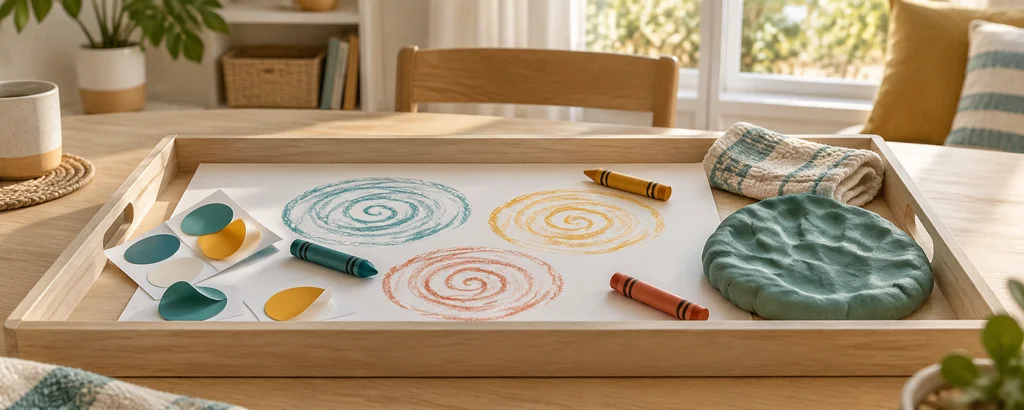
Put a large ball of age-appropriate play dough on a tray. Invite your child to flatten it with a palm, pinch a ridge around the edge, and press a pattern with the back of a large spoon. Pretend to take an order for one pancake or a long loaf.
Model each action slowly, then let the child choose. If the dough is too firm, an adult can soften it by kneading first. Skip tiny decorations and do not treat the dough as food. Check the product's ingredients if relevant to your child's allergies. For more pretend scenarios, try our role-play ideas.
4. Make a tape road
Give your child short strips of low-tack tape and a sheet of cardboard. Press the strips down to make a road, then run a finger or a large toy car along it. Add a parking space with another strip.
Fold back the tape ends so your child can peel up and rebuild the route. Use a cardboard surface rather than furniture, and test the tape first. A longer strip can be harder to control, so shorten it when it sticks to itself. This is a useful option when you want something that packs away in one piece.
5. Fold the toy's laundry
Use two or three small washcloths and a toy basket. Lay a cloth flat, bring two corners together, and pat the fold. Your child can copy the action or roll the cloth into a blanket for a stuffed animal.
Matching edges precisely is unnecessary. For a child who likes a challenge, ask whether the folded cloth will fit a smaller space. For a child who needs an easier start, hold one side steady while they move the other. Return the cloths to normal household use when the game ends.
6. Squeeze water between bowls
Place two shallow bowls on a towel, with a little water in one. Give your child a large sponge to soak, carry, and squeeze over the empty bowl. Stay within reach throughout and empty both bowls when finished.
If the sponge is too large to squeeze, use a smaller whole sponge suitable for your child's hands, without loose pieces. If water trails across the tray, move the bowls closer. A dry alternative is squeezing and releasing a soft washcloth before tucking it into a basket.
7. Draw roads with stops
Draw two large circles on paper and ask your child to connect them with a crayon road. Add a third stop and let them choose where the road goes. Thick crayons may be easier to hold than narrow ones; let your child use a comfortable grip.
Avoid correcting every line. If the page slides, secure it with tape. A younger child can make a broad scribbled road, while an older child may enjoy curves around a drawn pond. Our art activities offer more ways to keep mark-making playful.
8. Run a picture-book library
Put three sturdy books beside a cushion. Let your child choose one, turn the pages, and place a paper bookmark beside a favorite picture with your help. Pretend to check the book out to a stuffed animal.
Start with thick pages if thin ones are frustrating. An older child can draw a simple checkout card; a younger one can point to the next book. The game is about handling books and choosing stories, not testing reading ability.
When an activity feels too hard
Change the material before asking for more effort: start a sticker corner, use softer dough, stabilize the paper, or offer a larger object. A few enjoyable turns are enough. The American Academy of Pediatrics gives broader context in its preschool hand and finger skills guide. If you have concerns about your child's development, discuss them with their pediatrician.
For children who would rather move first, try indoor gross motor activities, then return to a tabletop choice. For a quieter afternoon, pair one hand activity with our quiet-time ideas.
FAQ
What are fine motor activities?
They are activities that involve small hand and finger movements, often together with looking at what the hands are doing. Peeling a sticker, folding a cloth, and drawing a line are everyday examples.
How long should a preschooler do these activities?
Follow interest and comfort rather than a required duration. Offer one activity, help when needed, and stop when your child wants to finish or becomes frustrated.
Can I do fine motor play without beads or small parts?
Yes. Large stickers, paper, washcloths, chunky crayons, sturdy books, and age-appropriate dough offer plenty of options. Check materials for every child who can reach the play space.