
8 Indoor Gross Motor Activities for Preschoolers in Small Spaces
Indoor gross motor activities for preschoolers do not need a long obstacle course. A clear patch of floor can be enough for reaching, stepping, rolling, and changing direction. These eight ideas for ages 3–6 include quieter choices for apartments and ways to join in while seated.
Before starting, move breakable objects and check that the floor is dry and does not slip. Keep play away from stairs, doors that might swing open, and furniture used for climbing. Choose movements your child can manage comfortably; the variations are invitations, not tests.
Match the game to your space
If you have only room to stand or sit, try mirror movements, rainbow reaches, or slow-motion statues. With a short clear route, use tape stepping stones or a delivery walk. Sock rolling and floor sweeping need a small open patch. Choose the gentle animal parade only if there is room to turn without bumping furniture.
Eight ways to move indoors
1. Tape stepping stones
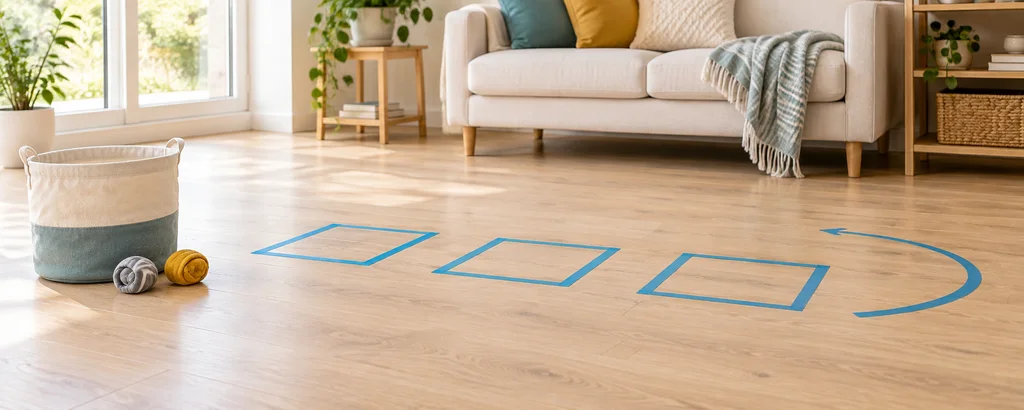
Make three broad squares on the floor with low-tack tape, testing the surface first. Invite your child to step into each square, pause, and step to the next. Keep every part on the floor; cushions and chairs are unnecessary.
Start with squares close together. An older preschooler can choose a different route or step sideways. For a quieter version, keep one foot on the floor at all times. If tape is not suitable for your floor, point to three existing floor tiles or describe three imaginary stepping spots.
2. Follow-my-mirror movements
Face each other with enough space to stretch your arms. Slowly raise one arm, reach across your body, or bend your knees a little. Your child copies the movement, then becomes the leader.
Keep the first sequence to two actions. Add a pause between actions if following is difficult. Both players can sit on stable chairs with feet supported and copy upper-body movements instead. Try making the movements deliberately slow so nobody needs to rush to keep up.
3. Rolled-sock bowling
Roll two socks together into a soft ball. Put three empty lightweight boxes at floor level and show how to roll toward them. Retrieve the sock together before taking another turn; avoid throwing it across the room.
Move the start closer if the boxes do not fall. For a seated version, position the target within a comfortable rolling distance. Children can also aim into a wide box lying on its side. The target can be shared, so a younger sibling does not need to compete against a stronger player.
4. Slow-motion statues
Choose an everyday action such as reaching for an imaginary apple or putting on a huge coat. Move through it slowly, then freeze when the leader says “statue.” Let the child decide when to move again.
No music is needed. If balancing feels difficult, allow both feet on the floor or use seated poses. Rather than eliminating someone who moves, invite everyone to change into a new statue. This keeps the game going without turning body control into a contest.
5. The soft-toy delivery walk
Place a basket a few comfortable steps away. Give your child a large soft toy to carry to its “home,” then walk back together. Change the destination for the next delivery or add a pretend doorbell sound.
Carry the toy in hands rather than balancing it on the head. An older child can follow a two-stop route; a younger one can repeat the same trip. If walking the route is not a good fit, bring two baskets within reach for seated reaching and placing. For more ways to share one activity, see our sibling play guide.
6. Rainbow reaches
Imagine a rainbow above you. Reach comfortably up with one arm, then sweep it across in a large curve. Try a low rainbow, a wide rainbow, and a tiny rainbow made just with a hand.
Stay within an easy range of movement and avoid pulling on a child's arms to enlarge the shape. This works seated or standing. A child who enjoys stories can use the rainbow as a bridge for an imaginary bird, choosing a new movement each time it lands.
7. Sweep the paper island
Crumple one large sheet of paper into a ball. Mark an “island” with a broad tape square or use a shallow cardboard tray. Invite your child to move the paper toward it using a small child-sized broom, keeping the broom near the floor.
No broom? Push the paper with two open hands while sitting on the floor. Use one ball at a time so the room remains clear. If the ball slides too far, move the island closer and make slower pushes. Remove tape and paper after the game.
8. A gentle animal parade
Choose three animals and a short route. Take tall giraffe steps, slow penguin waddles, then stand still like a heron with both feet down if preferred. Let your child invent an animal rather than copying a fixed exercise.
Skip fast running and big jumps in a small room. If a movement is uncomfortable, switch to making the animal's shape with arms or telling its story while seated. Finish by walking the route slowly as sleepy animals heading home.
Make an apartment-friendly movement break
Pick mirror movements, a few rainbow reaches, and a delivery walk. Keep feet on the floor, use soft objects, and avoid racing. Check how the space feels after the first round: if children keep colliding or targets land near furniture, shrink the movement and simplify the route.
Movement does not have to fill the entire afternoon. Follow it with a drink and a quieter option such as fine motor play. If you have a larger group and want cooperative rules, our indoor games for kids offers a different set of ideas.
Let the child choose the next round
Offer two choices: “Another delivery, or a mirror game?” Repeat a favorite instead of adding complexity every time. For a change of setting when conditions allow, use our outdoor activities, or generate a new idea for the time and space you have today.
FAQ
What indoor gross motor activities work in an apartment?
Mirror movements, rainbow reaches, slow-motion statues, and gentle delivery walks can keep feet on the floor. Clear the area first and choose a pace and space that work for your household.
Do I need to build an obstacle course?
No. A single target, a few tape squares, or copying a partner can provide a movement game without moving furniture or buying equipment.
How can a child join while seated?
Use stable seating and comfortable movements such as upper-body mirroring, reaching, placing toys between nearby baskets, or rolling a sock toward a close target. Adapt to the individual child rather than requiring every movement.