
7 Activities for Siblings of Different Ages to Do Together
Activities for siblings are easier to share when children can contribute in different ways. A three-year-old and a six-year-old may enjoy the same pretend town without building the same house or following identical instructions. These seven ideas are designed around preschool and early school-age children, with room to simplify when a younger sibling joins.
Choose materials that are safe for the youngest child who can reach them. Adults remain responsible for supervision; an older sibling can help by choice but does not need to become a teacher or babysitter. Give each child a starting role and permission to change it.
Set up shared play without requiring constant sharing
Create a shared goal, such as opening a café, and give each child a small personal workspace. Duplicate common supplies where practical: two crayons, two bowls, or two large toys can remove a predictable argument. Agree that one child asks before changing something the other has built.
Start with a short round. When interest or frustration changes, pause and offer a swap, separate versions, or an ending. Cooperative play does not require children to stay together for the whole afternoon.
Seven mixed-age activities
1. Build a two-neighborhood town
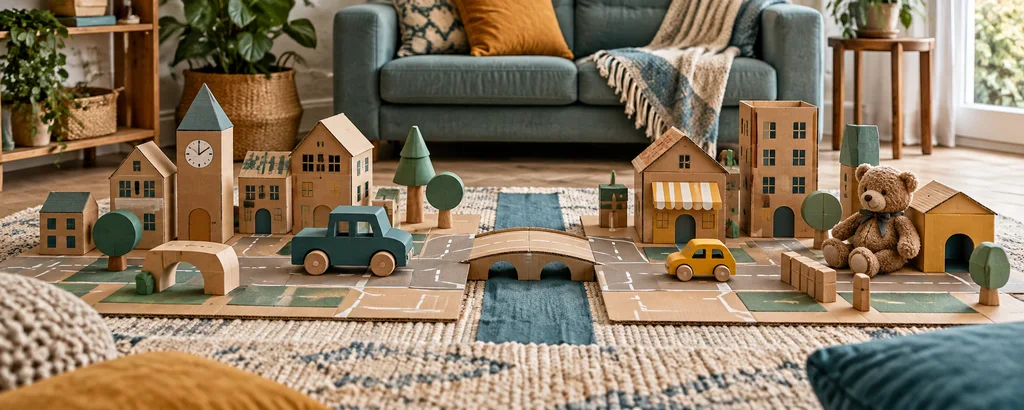
Put two cardboard sheets side by side. Each child creates a neighborhood with large blocks, drawn buildings, or small boxes. Connect them with a road only when both children are ready. A younger child can place buildings while an older one plans routes or draws signs.
Give each child a vehicle and ask what the town needs next. If one wants to demolish a building, mark a separate rebuilding area on their own sheet. The shared road stays available without giving either child control over the other's neighborhood. Our cardboard box ideas can supply a larger building later.
2. Open a pretend café
One child chooses the menu pictures while another sets out unbreakable pretend place settings. A third player or adult can be the customer. Orders can be spoken, pointed to, or drawn, so reading is optional.
Offer roles rather than assigning them by age. A younger child may want to take orders, and an older child may prefer preparing imaginary meals. Change jobs after one order if both want the same role. Use drawn food instead of small loose pieces when toddlers are nearby.
3. Make a shared art gallery
Give each child a sheet of paper and choose a broad theme, such as “somewhere a toy could go.” Work separately, then place the pictures side by side. Each child can describe their own picture or ask an adult to speak for them.
The older child's work does not need to be a model for the younger one. Avoid comparing detail or neatness. Instead, ask whether a character could travel between the two pictures. If children want a shared background, tape a fresh sheet between their pictures so neither original drawing needs to be changed.
4. Run a delivery service
Set out two baskets and a few large soft toys. Children choose jobs such as sorting the deliveries, carrying one toy, or announcing the destination. Make a short clear route and walk rather than race.
Swap jobs after a delivery or create two parallel routes if turns are difficult. A child who stays seated can choose the destination or move toys between nearby baskets. If the game becomes a competition, change the goal to getting all the toys home together without counting individual deliveries.
5. Go on a picture hunt together
Use the eight-picture sheet from our indoor scavenger hunt. One child chooses the next picture while the other spots the object, then swap. An older reader can read a clue if they want to; an adult can do it instead.
A younger child can point to an object already in plain sight. The older child can describe a feature or invent a new clue afterward. Use one shared checklist so the first person to spot an object does not automatically win the game. Keep everyone within the chosen supervised area.
6. Create a two-character show
Give each child a large toy or a cardboard tube character. Choose a simple problem: the characters want to visit a park but cannot decide what to bring. Each child supplies a sound, gesture, or line for their character.
An adult can narrate between turns. If the older child writes a long script, keep it for a separate version and let this shared show use short prompts. If the younger child repeats one action, make that repetition part of the story rather than correcting it. End with the characters agreeing on one next step.
7. Design a movement menu
Each child chooses a comfortable movement, such as reaching up, stepping sideways, or making a slow arm circle. Take turns leading one movement while the others join in as they can. Keep space between players and skip elimination.
Offer seated versions and keep the pace slow enough for everyone. An older child can combine two actions; a younger child can repeat one. Use our indoor gross motor guide for more small-space choices. The group goal is making a sequence together, not matching every movement perfectly.
When one child takes over
Describe the immediate problem without labeling either child: “That picture belongs to your sister. Ask before adding to it.” Then give a concrete next step, such as a fresh sheet for the shared road or two turns with the café menu. If a role requires skills one child does not yet have, change the role rather than asking the older child to correct them repeatedly.
When shared play is not working
Separate the materials and let children continue beside each other. Parallel versions still let them enjoy the same setting. Stop when someone is upset, tired, or wants their own space; there is no need to finish a project to prove they can cooperate.
For another day, begin with the activity both children returned to voluntarily. Keep the first setup simple and let the shared story grow from what they actually do. For a specific age, browse our guides for three-year-olds and five-year-olds.
FAQ
What activities can a toddler and an older sibling share?
They can play related roles in a pretend café, place large objects in a shared town, draw separate pictures for a gallery, or join a supervised picture hunt. Use materials suitable for the toddler and let the older child add complexity in their own space.
How do I stop the older child from doing everything?
Give each child a defined workspace or role, ask before changing another child’s work, and offer role swaps. Adults can help with difficult steps so responsibility does not automatically fall to the older child.
Is it okay if siblings play separately after starting together?
Yes. Let them continue with separate versions or take a break. The activity is an invitation to share some play, not a requirement to cooperate continuously.