
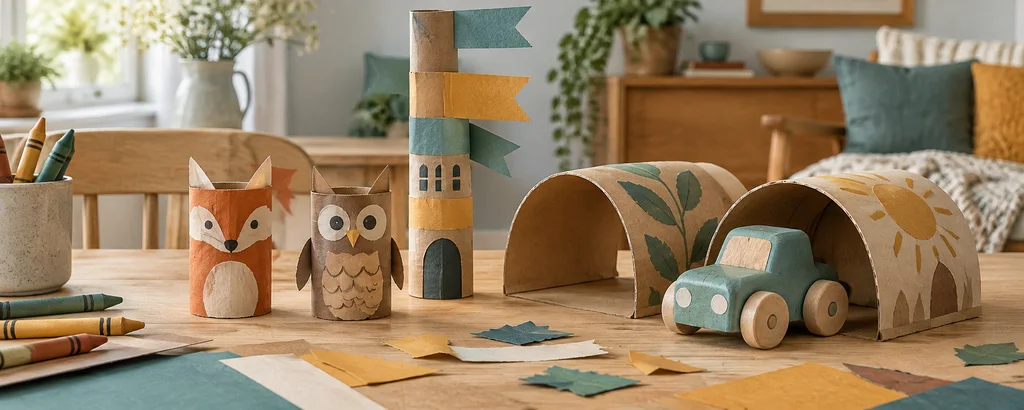
6 Cardboard Tube Crafts for Kids to Make and Reuse
Cardboard tube crafts for kids work especially well when the tube becomes part of a game. These six ideas for ages 3–6 use clean, dry tubes, paper scraps, crayons, and tape. Make one character or structure first, then add more only if the play needs it.
Use tubes from clean paper packaging or roll a sheet of thin cardboard into a tube and tape its seam. Discard wet, dirty, or damaged cardboard. An adult handles difficult cutting and checks for staples or sharp edges. Keep supplies suitable for the youngest child nearby, with drawn features instead of small attached decorations.
Start with what you have
Short tubes suit characters and buildings. Wide tubes can become tunnels if a toy fits through. Thin homemade paper tubes are easiest to reshape. No paint is necessary: crayons or strips of paper attached with a glue stick can add color without a long drying wait.
Six make-and-play projects
1. A woodland character
Stand a short tube upright and draw a large face near the top. Add a broad paper oval for a belly or draw it directly on the cardboard. An adult can cut two large paper ears and tape them to the inside rim, checking that the joins hold.
Make a bear, fox, owl, or invented creature. Younger children can choose colors and scribble the body; older children can create the whole character. Play afterward by giving the animal a home made from a small box. If ears keep falling off, draw them on a paper background behind the tube instead.
2. A town of tube towers
Stand several tubes on a large cardboard base and draw doors and windows. To anchor a tower, an adult cuts four short slits around its bottom edge. Fold the resulting tabs outward and tape them to the base. Leave enough space between towers for a large toy car.
Start with one home and one destination, such as a library. Your child can draw the road between them and decide who lives where. If a tower leans, use a shorter tube or wider base. This works alongside our cardboard box activities.
3. A tunnel for a toy car
Check whether a large toy car fits through a wide tube. If it does, tape the tube to a flat cardboard sheet so it cannot roll. Draw a road leading in and out. Push the car through slowly and describe where it is going.
If the tube is too narrow, an adult can cut it lengthwise into a half-tunnel, or bend a strip of cardboard into a larger arch. Do not switch to marbles or tiny cars just to make them fit. Add a second tunnel only after the first is working, and keep the route at floor or table level.
4. A pretend flower pot
Use a short tube as a small pot. Decorate its outside, then help your child draw a large flower on stiff paper with a broad stem. An adult cuts the flower in one piece, leaving the stem wide enough to stand inside the tube. Tape the stem to the inside wall if it tips.
Make a pretend flower shop where customers choose colors or invent flower names. There is no need for real soil, water, sticks, or wire. If the flower is top-heavy, shorten the paper stem. Children can trade drawn bouquets without needing identical crafts.
5. A rolling pattern tool
Wrap a broad strip of paper around a tube and tape the seam. Draw lines, dots, or zigzags around the outside. Roll it slowly across a table, noticing how the pattern disappears and returns. Try a second design with a wide stripe to make the rotation easy to see.
This is a dry observation game rather than a paint-printing project. Ask an older child to predict which mark comes next; let a younger one roll it between two hands. If the tube rolls away, work inside a shallow tray. Do not throw it or use it to hit other toys.
6. A tube-character theater
Make two simple tube characters and place them behind a low cardboard strip standing on the table. An adult folds the strip's ends backward to support it. Move the characters into view one at a time and give each a short line or sound.
A beginning story can be as small as one character asking where the other wants to go. Let your child change the ending. If holding and speaking at once is difficult, the adult moves a character while the child supplies its voice. For more prompts, try our imaginative play guide.
Fix the common assembly problems
Tape joins onto dry cardboard and press them firmly. If glue will not hold a curved part, use a paper band around the tube instead. Shorten tall pieces that keep tipping, and replace a crushed tube rather than adding a lot of repair tape. A rough-looking toy that works is more useful than a delicate model children cannot handle.
Keep unfinished paper parts in a large envelope. Store finished tubes upright in a small box so they can return to play later. When the interest has passed, remove reusable parts and follow your local rules for recycling the remaining materials.
Let siblings build related projects
Give each child a tube and a separate section of a shared cardboard town. One might make a home while another makes a theater. Join the sections with a drawn road when both are ready. See our sibling activities for ways to handle different ages and interests, or try paper plate crafts for another material you may already have.
FAQ
What can I use instead of a toilet paper tube?
Use a clean tube from paper packaging or roll thin cardboard into a tube and tape the seam. A homemade tube also lets you choose a width that fits your toy or project.
Can children make cardboard tube crafts without paint?
Yes. Draw directly on the cardboard with crayons or attach broad paper bands. All six projects here can be made without wet paint.
Who should cut the cardboard tubes?
An adult should handle difficult or thick cardboard cuts and check the edges afterward. Children can decorate and assemble, with supervised use of age-appropriate scissors for manageable paper pieces.