
7 Easy STEM Activities for Preschoolers at Home
STEM activities for preschoolers can start with a question as small as “Will this stand up?” You do not need a science kit or a worksheet. These seven ideas for ages 3–6 use ordinary materials to explore science, technology, engineering, and math through making, noticing, and trying again.
Choose one investigation and leave room to repeat it. An adult should stay with water activities, use only a shallow amount, and empty it afterward. Keep materials large enough for any younger child sharing the space.
Choose a starting point
For almost no setup, try shadow tracing or the block pattern. For a tabletop challenge, choose paper towers or a toy shelter. Absorbency and floating need a tray and towel. The paper fan is a dry alternative if you do not want water today. Allow roughly 10–20 minutes, but let your child's interest set the pace.
Setup estimates: allow about two minutes to gather dry supplies and three to five minutes for a water tray and towel. These are planning estimates, not tested timings. Stay involved for the first attempt and throughout water play.
Seven investigations to try
1. Which paper shape stands tallest?
Materials: three sheets of paper and a little tape. Leave one sheet flat, fold another into a tent, and help roll the third into a broad tube. Place each on the table and ask which can stand without a hand holding it. Let your child change the folds or widen the bottom before trying again.
A younger preschooler can compare the tent and tube. An older child can try making a taller version with the same amount of paper. If everything falls, shorten the structures and use a flat, steady surface. The useful discovery is how changing a shape changes what it can do; there is no required winning design.
2. Follow a toy's shadow
Materials: a large toy, paper, and a crayon. Beside a sunny window, position the toy so its shadow falls on the paper. Trace around the shadow, then turn the toy or move it nearer the paper. Ask what changed and what stayed the same. Never look directly at the sun.
Cloudy day? An adult can hold a flashlight while the child arranges the toy. Keep the light out of eyes. If the edge looks fuzzy, move the toy closer to the paper. Save the first outline so you can compare shapes instead of trying to remember them.
3. Where did the water go?
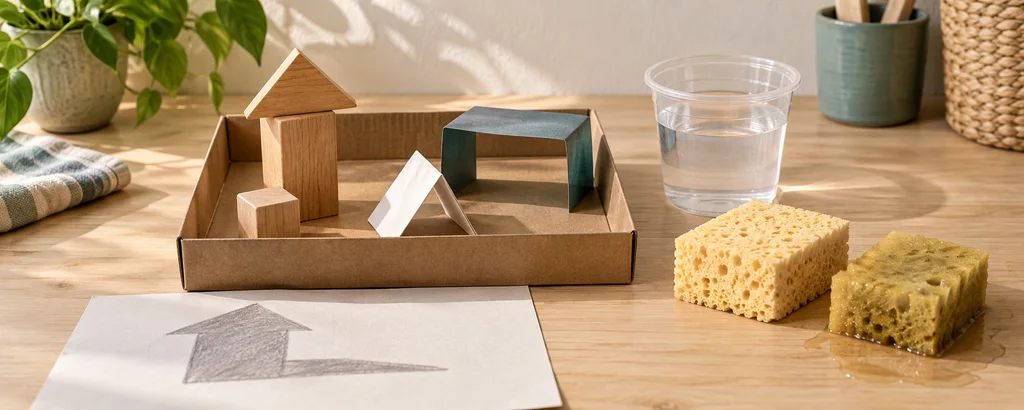
Materials: a shallow tray, a small cup of water, a sponge, a washcloth, and a sheet of plastic from a clean reusable bag. Put a spoonful of water on each material and watch. Does it soak in, spread, or stay on top? Squeeze the cloth and sponge over the tray to see whether you can get some water back.
Start with two materials for a younger child. For an older child, use the same spoon and amount each time so the comparison is easier to discuss. Skip measuring exact capacity; differences in material size would make that a different experiment. Dry spills before moving on.
4. Build a shelter for a toy
Materials: large blocks, a sheet of thin cardboard, and a toy animal. The challenge is to make somewhere the animal fits with a roof overhead and an opening it can pass through. Ask your child to check the entrance before finishing the roof.
If the roof sags, try moving the supports closer together or folding the cardboard. If the animal will not fit, choose one change: a wider doorway or a higher roof. Take the shelter apart and make a second design. Find more open-ended construction in our building activities for kids.
Have different objects on hand? Photograph your toys or materials in Brincaidea to get another activity idea matched to what is available.
5. Make and repair a pattern
Materials: two colors or shapes of large blocks. Begin a short repeating sequence: red, blue, red, blue. Invite your child to add the next block, then swap roles and follow their pattern. Move one block and ask whether the sequence still matches the rule.
A child who is new to patterns may prefer copying a two-block pair. An older preschooler can invent a three-part repeat or describe the rule without naming colors. Use shapes or textured objects if color alone is not a useful clue.
6. Can a paper fan move it?
Materials: paper and a large crumpled paper ball. Fold the sheet back and forth to make a fan. Place the ball on a clear table and wave the fan toward it. Try changing your distance, then the size of the ball. Keep the rest of the setup the same while exploring one change.
If nothing moves, use a lighter ball and hold the fan closer. Do not blow small pieces through straws. The fan is a simple tool your child makes to solve a problem; this is one way to explore technology without a screen.
7. Make a floating foil tray
Materials: a large piece of foil, a shallow water tray, and two large plastic toy figures. An adult checks for sharp foil edges while helping fold a broad tray with raised sides. Place it gently on the water, then put one figure near the center. Try repositioning the figure or making the base wider if the tray tips.
Use toys too large to swallow instead of coins. A younger child can place the empty tray and describe what happens. An older child can compare two tray shapes using the same toy. Stop when the foil tears and empty the water together.
Help without taking over
Try “What could we change?” or “Show me what happened” before offering a solution. A collapsed tower can lead to another attempt, and a child who prefers arranging materials may still be exploring. NAEYC's family guide to tinkering describes open-ended exploration as a useful part of STEM learning.
For an autumn version, sort broad fallen leaves by shape, then compare how their shadows look. Our fall activities guide has more seasonal play. Older siblings who want a more structured investigation can use our science experiments for ages 8–10.
Finish with one observation
Ask your child to show a favorite design or draw what changed. Writing an answer is optional. Keep the most useful materials in a small box so the investigation can start again another day, and use Brincaidea's activity generator when you want an idea matched to your available materials.
FAQ
What does STEM mean for preschoolers?
STEM means science, technology, engineering, and math. For a preschooler, it can mean comparing materials, making a simple tool, changing a structure, or noticing a pattern through play.
Do preschool STEM activities need special equipment?
No. Paper, large blocks, a toy, and everyday containers are enough for several activities here. Choose a dry activity if you do not have space to supervise water play.
How do I make a STEM activity easier for a three-year-old?
Offer two materials or one change at a time, demonstrate the first action, and accept showing or pointing instead of a spoken explanation. Stop or simplify when the challenge becomes frustrating.